Saona Island Tour for Travelers With Limited Mobility: Accessibility Questions Before Booking
Saona Island is a popular excursion destination in the Dominican Republic, known for its clear water, tropical scenery, and sandy beaches. However, enjoying a boat trip and spending time on a beach can involve physical challenges for travelers with limited mobility.
If you use a wheelchair, walker, cane, or other mobility aid—or find it difficult to stand for long periods, climb steps, or walk on uneven surfaces—planning your Saona Island excursion requires more than choosing a tour based on its photos.
Accessibility can vary depending on the departure point, boat, transportation vehicle, landing location, and facilities available on the day. A tour described as relaxing or suitable for families should not automatically be considered accessible.
This guide explains the main mobility considerations and provides specific questions to ask a tour operator before you pay for your excursion.
Is Saona Island Accessible for Travelers With Limited Mobility?
There is no single answer for every traveler or tour. Accessibility depends on your individual needs and the arrangements offered by the specific operator.
Some parts of an excursion may be manageable while others may present difficulties. For example, reaching the departure point could be straightforward, but boarding a boat may require stepping across a gap, climbing steps, or maintaining balance. At the destination, soft sand can make wheelchair movement difficult, even when the beach itself is easy to see from the boat.
Before booking, evaluate the entire journey rather than just the destination.
Consider these five stages:
- Transportation from your hotel or meeting point
- Access to the departure dock
- Boarding and leaving the boat
- Moving around the beach and swimming areas
- Access to restrooms, shade, seating, and other facilities
Ask the operator about each stage separately. A general statement such as “the tour is easy” does not explain whether the arrangements meet your specific mobility requirements.
1. Explain Your Mobility Needs Before Booking
Start by describing the assistance or equipment you use. Different mobility needs can require very different arrangements.
For example, a traveler who uses a cane but can climb a few steps may need different support from someone who uses a wheelchair full-time or cannot stand without assistance.
When contacting the tour operator, explain:
- Whether you use a manual wheelchair, powered wheelchair, walker, cane, or another aid
- Whether you can stand and take a few steps independently
- Whether you can climb stairs or need step-free access
- Whether you can transfer from a wheelchair to a boat seat
- Whether you need another person to assist you
- Whether you have difficulty walking on sand or uneven ground
- Whether you need frequent seating breaks or access to a restroom
Share only the information needed to determine whether the excursion is suitable. If your mobility needs are complex, ask the operator to discuss the practical arrangements with you before confirming the reservation.
Important: Do not assume that a boat crew can lift you or your wheelchair safely. Any transfer assistance, lifting arrangement, and equipment-handling procedure should be explicitly discussed and confirmed in advance.
2. Ask About Wheelchair and Mobility Aid Access
One of the most important questions is whether your mobility aid can be accommodated throughout the excursion.
A wheelchair-friendly hotel transfer does not necessarily mean the boat or beach is wheelchair-accessible. Similarly, a tour operator might allow a folded wheelchair to be carried without having a suitable method for moving a wheelchair user onto the boat.
Ask the operator:
- Can my wheelchair or mobility aid be transported on the vehicle and boat?
- Is there a weight, size, or storage limitation?
- Can I remain in my wheelchair during boarding, or would a transfer be necessary?
- Is there a ramp, lift, or other suitable boarding arrangement?
- If I use a powered wheelchair, are there restrictions related to its dimensions or battery?
- Can the mobility aid be kept nearby and returned when needed?
- Who, if anyone, is responsible for assisting with transfers?
Get clear answers about your exact equipment rather than relying on a general statement that wheelchairs are allowed.
If the operator cannot confirm safe transport and boarding arrangements, consider a different excursion or ask whether an alternative arrangement is available.
3. Check Boat Boarding and Disembarking Conditions
Boat access can be one of the most physically demanding parts of a Saona Island excursion.
Depending on the departure location, vessel, water conditions, and landing arrangements, boarding may involve steps, a narrow passage, a gap between surfaces, or movement caused by the boat. Leaving the boat at the destination may involve different conditions from boarding at the dock.
Ask the operator these questions before booking:
- How do passengers board the specific boat?
- Are there steps, steep ladders, narrow entrances, or gaps to cross?
- Is the boarding area stable, and does the arrangement change with the tide or water conditions?
- Is step-free boarding available for this departure?
- Can a passenger who cannot climb steps be accommodated?
- What assistance is actually available from the crew?
- Are passengers required to step into shallow water to reach the beach?
Do not assume that a large catamaran is automatically more accessible than a speedboat, or that a smaller boat is necessarily easier to board. Vessel design and boarding procedures matter more than the boat category alone.
If you are comparing vessel types, read our guide to Saona Island speedboat vs. catamaran tours and ask the operator about the accessibility of the exact vessel being used.
4. Understand the Challenges of Walking or Rolling on Sand
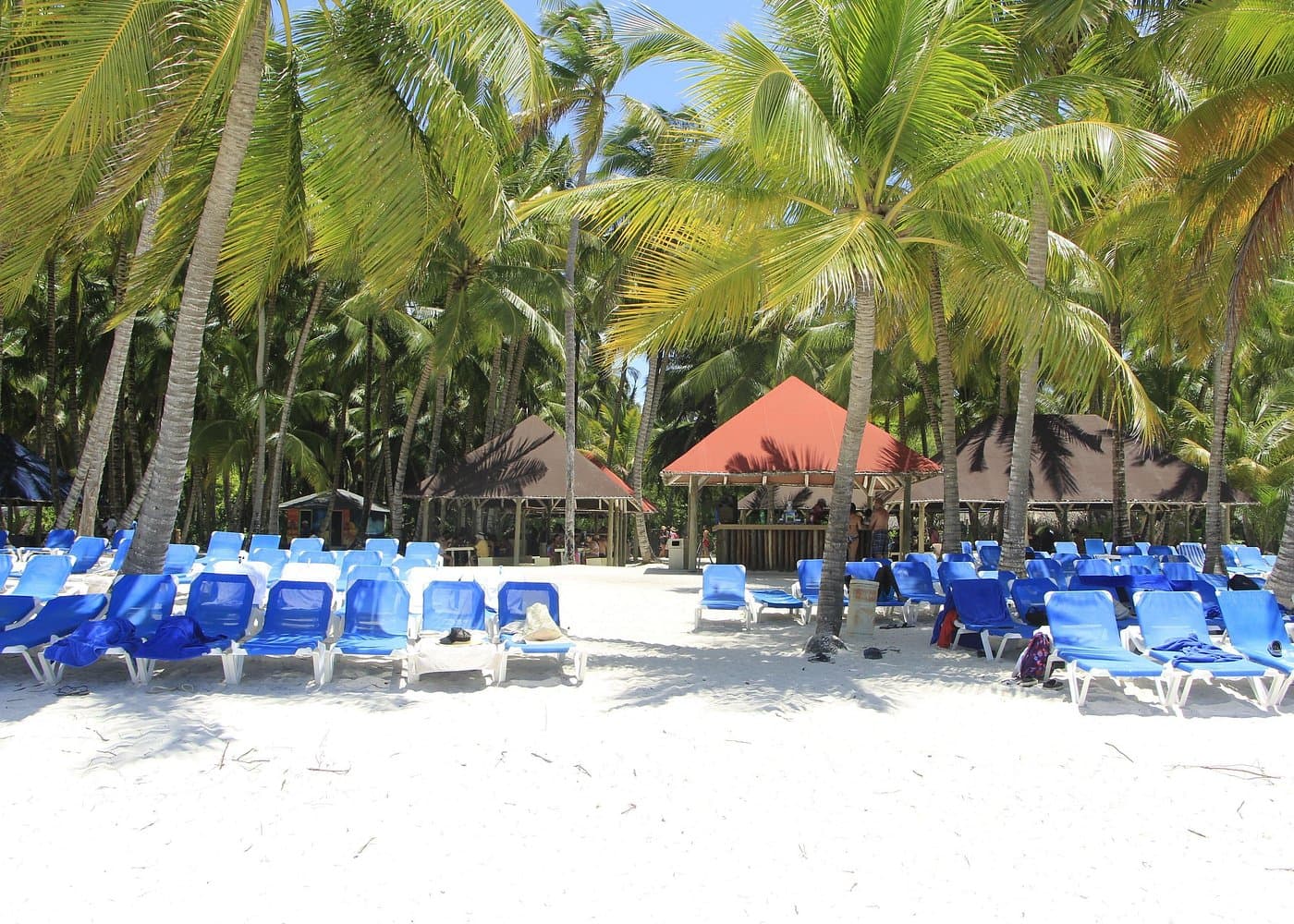
A beach may appear flat in photographs, but soft sand can be difficult to navigate with a wheelchair, walker, cane, or limited balance.
Standard wheelchair wheels can sink into loose sand. Walkers may not provide reliable support on an uneven surface, and a cane can become unstable when its tip sinks into the ground. Wet sand near the water may be firmer in some places, but it should not be assumed to provide a continuous, accessible route.
Before booking, ask:
- Where does the boat arrive at the beach?
- How far is the usual landing point from the seating or rest area?
- Is there a firm, level route from the landing area?
- Would I need to walk through loose sand or shallow water?
- Are accessible beach mats or suitable mobility equipment available?
- Can I remain near the landing area if moving farther along the beach is difficult?
- Is there a shaded place to rest without crossing a long stretch of sand?
Ask for a practical description of the route, not simply whether the beach is accessible.
If you cannot move safely across sand, determine whether you could still enjoy the excursion while remaining in a suitable area. If no safe arrangement is available, another destination or a different type of excursion may be more appropriate.
5. Confirm Hotel Transfers and Ground Transportation
Transportation is another part of the journey that needs individual confirmation.
A standard tour vehicle may have ordinary passenger steps and limited room for mobility equipment. Even if you can enter the vehicle, your wheelchair or walker may not fit in the luggage compartment.
Ask the operator or transportation provider:
- Is the vehicle step-free or equipped with a ramp or lift?
- Is there enough space for my mobility aid?
- Can I enter and exit the vehicle safely?
- Is a suitable seat available?
- How long is the journey from my hotel or meeting point?
- Will there be additional walking between the vehicle and departure dock?
- Is an accessible private transfer available if the standard transfer is unsuitable?
If you arrange your own transportation, confirm the exact meeting location and the distance from the drop-off point to the boarding area.
For more planning advice, see our guide to transportation for Saona Island tours. Confirm that any recommended option meets your individual needs before reserving it.
6. Check Restrooms, Seating, Shade, and Other Facilities
Physical accessibility is not limited to boarding a boat or reaching the beach. You may also need reliable access to a restroom, comfortable seating, shade, and a place to rest.
Facilities can vary by vessel, beach stop, and excursion itinerary. Do not assume that a restroom is wheelchair-accessible simply because one is available.
Ask:
- Is a restroom available on the boat or at the planned beach stop?
- Is the restroom accessible for someone with my mobility needs?
- Are there steps or narrow entrances?
- Are seats available throughout the excursion?
- Is shade available near the seating area?
- How much time is spent at each stop?
- Can I remain seated if I do not want to participate in a particular activity?
Also consider heat and sun exposure. Waiting in a boarding area or sitting on an exposed boat can become uncomfortable, particularly if you need frequent breaks.
Bring water, sun protection, and any personal supplies you normally need. If you require regular medication or specialized support, plan how you will manage it during the excursion.
7. Consider a Private or Customized Excursion
A private tour may offer more flexibility than a group excursion, but it is not automatically accessible.
Depending on the operator, a private arrangement may allow you to discuss departure timing, reduce unnecessary transfers, choose a suitable boat, or spend more time at a manageable location. However, it does not guarantee a ramp, lift, accessible restroom, trained transfer assistance, or a beach route suitable for a wheelchair.
Before paying extra for a private tour, ask exactly which arrangements can be changed.
Useful questions include:
- Can the itinerary be adapted to reduce walking?
- Can we discuss boarding requirements before choosing a boat?
- Can the departure and return times be adjusted?
- Can the group avoid activities that require climbing, standing, or entering the water?
- Can the operator confirm the vehicle, vessel, and landing arrangements in writing?
A customized tour is worth considering only if the operator can confirm that the changes address your actual requirements.
8. Should You Choose a Speedboat or Catamaran?
The best option depends on your mobility needs and the accessibility of the particular vessel.
ConsiderationWhat to verifyBoardingSteps, gaps, ramps, and available assistanceSeatingEase of reaching a seat and remaining seatedMovementSpace to move safely around the vesselMobility aidsStorage, weight limits, and handling proceduresBeach arrivalWhether passengers must step into water or cross sandJourney comfortTrip duration, movement, and opportunities to rest
Do not select a boat based on its name or size alone. Ask which vessel will be used and request details about its boarding arrangements.
If you are sensitive to boat movement or need to remain seated, discuss that with the operator as well. A tour that appears convenient on paper may still be unsuitable if the boarding process or journey creates difficulties.
9. Create an Accessibility Checklist Before Paying
Use this checklist when comparing excursions. A booking should not be considered confirmed as accessible until the important details have been answered clearly.
- My mobility needs have been explained to the operator.
- My wheelchair, walker, or other aid can be accommodated.
- The boarding and disembarking procedures have been explained.
- Any required transfer assistance has been discussed.
- The transport vehicle and meeting-point route are suitable.
- Beach access and the distance across sand are understood.
- Restroom and seating arrangements have been checked.
- Shade and opportunities to rest have been discussed.
- The operator has explained what happens if conditions change.
- The key arrangements have been confirmed in writing.
If several essential questions remain unanswered, do not assume the tour will work on the day. Ask for clarification before making a non-refundable payment.
10. What to Do if the Operator Cannot Confirm Accessibility
An operator may not be able to accommodate every mobility requirement. That does not necessarily mean the operator is unhelpful; the vessel, dock, beach conditions, or available equipment may simply impose limitations.
If the answers are unclear, you can:
- Ask whether a different vessel or departure point is available.
- Request details about an alternative transfer or private arrangement.
- Ask whether the operator can accommodate a shorter or modified itinerary.
- Compare another excursion with more suitable confirmed facilities.
- Choose a different activity if the essential safety requirements cannot be met.
Be cautious of vague promises such as “no problem” or “we will help you when you arrive.” Ask what the assistance involves, who will provide it, and whether it is available for your specific needs.
Do not rely on an assumption that staff will be able to carry you, lift heavy equipment, or make an inaccessible route safe.
Message Template: Ask a Tour Operator About Accessibility
You can send the following message before making a reservation.
Subject: Accessibility Questions for a Saona Island Tour
Hello,
I am interested in booking a Saona Island tour, but I have limited mobility and would like to confirm whether your excursion is suitable before making a reservation.
My mobility requirements are: [briefly describe your needs and any mobility aid you use].
Could you please confirm the following?
- Can your transportation vehicle accommodate my mobility aid and any assistance I require?
- How do passengers board and leave the boat?
- Are ramps, steps, or transfers required?
- Can my mobility aid be carried and stored safely?
- Will I need to walk through loose sand or enter shallow water?
- Are suitable seating, shade, and restroom facilities available?
- What assistance can your staff provide, and are there any restrictions I should know about?
Please confirm which arrangements are available for the specific tour and vessel I would be booking.
Thank you.
Frequently Asked Questions
Can wheelchair users visit Saona Island?
It depends on the specific excursion, wheelchair, transportation arrangements, boat access, and landing conditions. Do not assume that a standard tour is wheelchair-accessible. Confirm each stage of the journey with the operator before booking.
Are Saona Island boat tours suitable for people who use walkers or canes?
Some travelers who use walkers or canes may be able to manage certain excursions, but boarding, boat movement, uneven surfaces, and soft sand can create difficulties. Explain your needs and ask about the exact physical requirements before reserving a tour.
Can a tour operator help me get onto the boat?
Assistance varies by operator and vessel. Ask what assistance is available and whether the crew can safely accommodate your specific needs. Do not assume that lifting or transfer assistance will be provided.
Is a private Saona Island tour better for someone with limited mobility?
A private tour may allow more flexibility in timing or itinerary, but it is not automatically accessible. Confirm the transportation, vessel, boarding process, landing location, and facilities before paying for a private arrangement.
Are the beaches on Saona Island wheelchair-accessible?
Accessibility depends on the landing location, sand conditions, route, and equipment available. Loose sand can be difficult for standard wheelchairs. Ask whether a firm, level route or suitable beach-access equipment is available at the planned stop.
What should I do if accessibility details are not available online?
Contact the operator directly and request written answers about the parts of the journey that matter to you. If essential arrangements cannot be confirmed, compare other excursions or consider an alternative activity.
Should I book first and explain my mobility needs later?
No. Discuss your requirements before booking, particularly if you need step-free boarding, a specific transfer arrangement, space for a mobility aid, or accessible restroom facilities. This gives the operator an opportunity to confirm suitability before you commit.
Conclusion: Confirm the Details Before Your Saona Island Excursion
A Saona Island trip may be appealing, but travelers with limited mobility should evaluate the entire excursion—not just the beach destination.
The most important details are transportation, boat boarding, safe handling of mobility aids, movement across sand, restroom access, seating, and the availability of any required assistance.
Explain your needs clearly, ask specific questions, and request written confirmation of the essential arrangements. If an operator cannot verify that the trip is suitable, consider a different vessel, a customized option with confirmed accommodations, or another excursion.
The best tour is not simply the one with the most attractive photos. It is the one whose actual arrangements match your mobility needs and allow you to participate as safely and comfortably as possible.
Local explorer & expert guide in Boat Tour Samana.